Posts tonen met het label books. Alle posts tonen

zaterdag

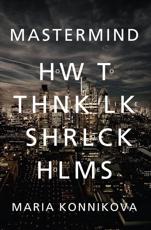
HOW TO THINK LIKE SHERLOCK HOLMES

Now, with new Sherlocks appearing everyday, somebody's got the idea to interrogate the interrogator:

What is it that separates Sherlock Holmes from his long-suffering friend and side-kick Dr John Watson? 
What makes Holmes such a superior detective, able to piece together clues and solve problems that seem elementary to Watson only in hindsight? 
This book puts 21st century neuroscience and psychology in service of understanding Holmes' methods.

What is it that separates Sherlock Holmes from his long-suffering friend and side-kick Dr John Watson? What makes Holmes such a superior detective, able to piece together clues and solve problems that seem elementary to Watson only in hindsight? And can we - most of us Watsons ourselves - ever harness a bit of Holmes' extraordinary powers of mind, not to solve crimes, but simply to improve our lives at work and home? The answer is yes, and in "Mastermind", psychologist Maria Konnikova shows us how. Using plots and passages from the wonderfully entertaining Holmes stories, she illuminates how Arthur Conan Doyle's detective embodies an ever-present mindfulness, and how this active mental disposition proves foundational to his success. Beginning with Holmes' concept of the 'brain attic' - a metaphor for the information we choose to store in the mind and how we organise our knowledge, Konnikova unpacks the mental strategies that lead to clearer thinking and deeper insights. Moving through principles of logic and deduction, creativity and imagination, "Mastermind" puts 21st century neuroscience and psychology in service of understanding Holmes' methods. With some self-awareness and a little practice, we can all employ these methods to develop better strategies, solve difficult problems and enhance our creative powers. Writing for Holmes fans and casual readers alike, Konnikova has translated what so many of us love about the great detective into a remarkable guide to upgrading the mind.


ISBN: 9780857867247 - Mastermind

BLACKWELL BOOKSHOP

woensdag

MARIO PRAZ [ROME]

My trips to Rome have been numerous and I even lived there for a short time, trying to join the film industry. To me it always remained a miracle city. Mysterious, dirty, sensual, splendid, overwhelming, and so on. All you can think of, is true. One of it's most well hidden treasures is Mario Praz's house La Casa Della Vita. It is a treasure box, a time capsule and an intellectual challenge in one.
Mister Praz was a thinker and a writer. He conceived An Illustrated History of Interior Decoration: From Pompeii to Art Nouveau. And actually that's how I got to know about his existence.


A book I really love

So, when in Rome, don't do as the Romans do, as they would never go to this house of life, but pay this great scholar a visit. 

Fodor says: On the top floor of the Palazzo Primoli is one of Rome's most unusual museums. 

As if in amber, the apartment in which the famous Italian essayist Mario Praz lived is preserved intact, decorated with a lifetime's accumulation of delightful baroque and Neoclassical art and antiques arranged and rearranged to create symmetries that take the visitor by surprise like the best trompe d'oeil. As author of The Romantic Sensibility and A History of Interior Decoration, Praz was fabled for his taste for the arcane and the bizarre; here his reputation for the same lives on. 

The apartment can only be seen on group tours.


Museo Mario Praz, Palazzo Primoli. Via Zanardelli 1, Roma

Open Tu - Sun 9am-1pm and 2:30-6:30pm
Guided tours every hour / Closed on Mondays

1,200 objects, late 18th to mid 19th centuries, collected by Mario Praz.
All described in his book La Casa della Vita ("The House of Life")
Some notes in Dutch on his most famous book: The Romantic Agony.

Mario Praz, Italiaans criticus (Rome 06-09-1896 - Rome 23-03-1982)

The romantic agony, 1933
Wie graag wil geloven dat de literatuur van de negentiende eeuw braaf, saai en bekrompen is geweest, doet er goed aan The romantic agony van Mario Praz ongelezen te laten. Want dit boek zou hem of haar wel eens op andere gedachten kunnen brengen. In 1930 verscheen het voor het eerst als La carne, la morte e il diavolo nella letteratura romantica, maar het is onder haar Engelse titel (de vertaling verscheen al in 1933) dat Praz' studie van de 'erotische sensibiliteit' in de romantische letteren de wereld heeft veroverd.
Met trefwoorden als Satan, Sade, La Belle Dame Sans Merci, Byzantium en le vice anglais legt Praz in de literatuur van de vorige eeuw troebele lagen bloot die eerdere onderzoekers liever over het hoofd hadden gezien. Zijn boek is een adembenemende inventarisatie van de literaire vermommingen die een - vaak onderdrukte - seksualiteit had aangenomen in de eeuw die voorafging aan Freuds ontdekking dat eigenlijk aan al ons doen en dromen seksuele impulsen ten grondslag liggen.
Veel van wat Praz beschrijft was ook vóór de Romantiek aanwezig. Satan onderging zijn 'metamorfose' tot tragische rebel al in Miltons Paradise lost; dat gruwelen esthetische lust kunnen opwekken, wisten de tragedie-schrijvers al. Maar pas de romantici, voorafgegaan door de achttiende-eeuwse denkers van het 'sublieme', hadden van deze zaken een welbewuste sensibiliteit gemaakt, die zij als eersten volstrekt serieus namen en in hun romans en gedichten cultiveerden. Pas door hen werd de klassieke eenheid van het Schone, het Goede en het Ware definitief doorbroken, om plaats te maken voor een nieuwe schoonheid die heel goed met pijn, verval en dood gepaard kon gaan.
In het werk van Byron, Keats, Baudelaire, Flaubert, Swinburne, Huysmans, Wilde, Péladan en vele anderen weet Praz er de sporen van aan te wijzen, daarbij puttend uit een ontzagwekkende eruditie die niet alleen de alom erkende meesters, maar ook een ruime keus van tweede en derderangs auteurs omvat. Een lange rij van satanische helden, fatale mannen en vrouwen, exotische schoonheden en geselende zonderlingen passeert de revue. Wie niet beter weet zou menen dat de hele literatuur van de negentiende eeuw van afwijkingen en perversies aan elkaar hing.
Sommige negentiende-eeuwers waren daar ook zonder het door Praz zo belangeloos verzamelde bewijsmateriaal van overtuigd. Een van hen, de Duitser Max Nordau, trok in zijn destijds veelgelezen boek Entartung (1892-93) pagina's lang van leer tegen de ziekelijke verbeelding van de moderne literatuur, die hij symptomatisch achtte voor de 'ontaarding' van zijn tijd. Met behulp van Lombroso's theorieën over genie en waanzin reduceerde hij de romantische en decadente schrijvers tot psycho-pathologische gevallen, die hoognodig onder medische behandeling dienden te worden gesteld.
Tegen dit soort cultuur-kritische 'diagnoses' komt Praz in het geweer. In het voorwoord bij zijn boek verwijt hij Nordau pseudo-eruditie, grof positivisme en hypocriet moralisme. Maar zijn belangrijkste verwijt lijkt toch iets anders te zijn: een volstrekt onbegrip voor de aard van de literaire verbeelding. Een morbide thematiek hoeft geenszins te wijzen op een psychische stoornis bij de auteur, betoogt Praz. De schrijvers die door lieden als Nordau naar de dokter werden verwezen, waren geen 'monsters'; zij werden gedreven door obsessies die in ieder mens aanwezig zijn, maar die zij alleen openlijk tot uitdrukking durfden te brengen.
Voor Praz is dat laatste vooral een kwestie van literaire smaak, een bepaalde esthetische sensibiliteit, waarvan hij in zijn boek de ontwikkeling heeft willen schetsen. Meer niet. Aan psychologische verklaringen heeft hij geen boodschap; evenmin stelt hij zich op als een bezorgde moralist, wat niet wil zeggen dat hij instemt met alles wat hij beschrijft.
Maar als er een oordeel wordt uitgesproken, gebeurt dat alleen op literaire gronden, zoals in het geval van de markies de Sade, die op de romantische en decadente literatuur van de negentiende eeuw zo'n sinistere 'schaduw' had geworpen. Dat Sade als eerste het 'mechanisme van de homo sexualis' heeft onthuld is volgens Praz nog geen reden om hem, in navolging van de surrealisten, tot een literair genie uit te roepen. 'De meest elementaire kwaliteiten van een schrijver - laat staan een geniaal schrijver - ontbreken bij Sade', luidt het strenge oordeel.
Tegen de kritiek van Benedetto Croce, die hem had verweten een eenzijdig beeld van de Romantiek te geven, verdedigt Praz zich met het argument dat hij slechts een 'monografie' en geen 'synthese' heeft geschreven. In werkelijkheid moet de oorsprong van zijn boek nog eenzijdiger zijn geweest. Want Praz, die tussen 1924 en 1934 in Engeland Italiaanse letterkunde doceerde en daarna tot aan zijn emeritaat in 1966 Engelse letterkunde in Italië, was zijn carrière begonnen met publicaties over Gabriele D'Annunzio en diens literaire bronnen. In The romantic agony zijn die bronnen een zelfstandig leven gaan leiden, al wordt D'Annunzio in het slothoofdstuk ('Byzantium') nog altijd de 'meest monumentale figuur van de Decadente Beweging' genoemd in wie alle elementen uit de voorgaande hoofdstukken samenkomen.
Een serieuzer beperking betreft de taalgebieden waaruit Praz zijn voorbeelden heeft geput. Bijna alle auteurs die in zijn boek worden behandeld zijn Engelsen, Fransen of Italianen. Daardoor ontbreken schrijvers als Strindberg, Wedekind, Sologoeb, George of Couperus, die zeker een plaatsje in The romantic agony zouden hebben verdiend. Dat is jammer, zoals Praz ook zelf erkent, maar geen doorslaggevend bezwaar, omdat uitbreiding van het materiaal de grote lijn niet wezenlijk zou hebben gewijzigd. De literaire smaak van de vorige eeuw werd tenslotte nog voor het overgrote deel in Londen en Parijs gemaakt.
Ook met een andere beperking valt te leven. Praz gaat niet verder dan 1900, hoewel er nadien tal van schrijvers zijn opgestaan die in hun werk van een verwante 'erotische sensibiliteit' blijk geven. Bij sommigen is zelfs sprake van wat je een selffulfilling prophecy zou kunnen noemen, aangezien zij die sensibiliteit mede aan Praz' boek, dat al snel een 'classic' werd, hebben te danken. Voor tijdgenoten als Bernanos, Kessel en Jünger (die in een noot door Praz zelf worden genoemd) gaat dat uiteraard niet op, maar wèl voor enkele schrijvers die pas veel later hun romantisch-decadente inborst ontdekten.
Het meest sprekende voorbeeld in Nederland, waar de negentiende-eeuwse literatuur vóór de komst van de Tachtigers vooral uit deugdzame domineespoëzie en gezapig realisme lijkt te bestaan, is Gerard Kornelis van het Reve. Volgens zijn vroegere echtgenote Hanny Michaëlis had hij The romantic agony al tijdens hun huwelijk 'verslonden'. In A prison song in prose (geschreven in 1960 en gepubliceerd in 1968) werden voor het eerst de gevolgen zichtbaar. De 'meedogenloze jongen' die daarin met kil genot de zweep hanteert, zou nadien nog vaak in zijn werk terugkeren, als een homoseksuele variant van Keats' 'Belle Dame Sans Merci' uit 1819.
Dankzij Mario Praz heeft Reve, die zich er altijd over beklaagde in een vacuüm te moeten schrijven, de literaire traditie gevonden waarin hij thuishoort. Het bewijst, anders dan zijn 'geleerde broer' Karel jaren later in diens Huizinga-lezing staande hield, dat de literatuurwetenschap niet altijd tot 'onleesbaarheid' hoeft te leiden.
Arnold Heumakers LINK NRC
Mario Paz: Lust, dood en duivel, in de literatuur van de romantiek. Vertaald door Anton Haakman. Agon, 518 blz. ƒ 49,90


Mario Praz

COGGLES

Some time ago I came across Coggles, a delightful digital dept. store. It has 'I want' written all over it.

The shop, was apparently named after the secretary of the former husband of founder Victoria Bage. The explanation for the name of the shop: Victoria's husband was caught having an affair with this secretary. Victoria divorced him and took revenge by the naming the shop to change the name of the secretary, Sarah Coggles. A strong reminder of the creativity rage can arouse.

Founded in 1974 in downtown York, it is now an online store with great content.
 

To visit this shop PRESS


DELVING INTO THE UNKNOWN

There was a time that the Bibliotheca Philosohica Hermetica seemed to go astray. Joost Ritman spend so much money on his life's passion that he went bankrupt. Nobody seemed willing to save his library, but recently the Bibliotheca reopened. 
 Joost Ritman comes from a family of Rosicrucians. He began collecting rare old books when he was sixteen, but his enthusiasm was really fuelled when his mother gave him a copy of Aurora, a work by the German Protestant mystic Jacob Böhme (1575-1624). The work also fed his interest in Hermetic  philosophy. In fifty years’ time he collected not only the essential works of Hermetism, but also related currents such as gnosis, theosophy, non-Western philosophy and  kabbalah. The core of the collection, however, consists of the Corpus Hermeticum. Like Cosimo de’ Medici, Ritman commissioned a translation of the Corpus Hermeticum, in Dutch, in 1990.


Joost Ritman is now only surrounded by family members in the library: his daughters Esther (director and librarian) and Mirjam (art historian and curator of the Ritman Art Collection) and his granddaughter Rixande. Ritman had to let go the academic staff formerly connected to the library. ‘The library is like a ship in a storm’, he says. ‘We had to steer it to a safe haven. The crew originally consisted of seven people, we are now carrying on with four. We are hiring our former staff on a freelance basis.’
To prevent attachment of the collection in the future, a new organisational structure has been designed for the library. The ownership of the collection has been entrusted to a foundation headed by the Ritman family. The right of usage of the library is held by a second foundation, which has an ANBI status, an official accreditation for charities, making donations tax deductible. The board is made up of Ritman’s daughter Mirjam, former Education and Culture minister Hedy d’Ancona, and Amsterdam notary public Maarten Meijer.

donderdag

GARDENING [5] BAWA

Together the Sri Lankan Bawa brothers put 'tropical retreat' design on the map. The brothers, Bevis and Geoffrey left their mark in Sri Lanka, where they originated, but also on Bali and the other beautifully beached HOT spots, from Bali to Bermuda.
Bevis was the gardener, Geoffrey the architect. His biggest achievement in worldly architecture probably being his Houses of Parliament in Colombo, capital of Sri Lanka.
But what the two of them together are really responsible for is the mark they put on tropical retreats.
The design of world famous hotels like the Balinese Amandari or the private housing compound of Taman Mertasari were all based on their invention of monsoon leisure.
The Taman Mertasari I visited mid nineties, was initiated by Brent Hesselyn and partners.  Brent was an Australian who ran the ceramic factory Jengala. [I say ran, because he was lost at sea in 2002] 
Geoffrey Bawa (1919-2003) is far better known than his brother. After training in England to be a lawyer, he turned to architecture. He designed the island’s Parliament complex as well as many other public buildings but made his reputation with his hotels, like the mile-long Heritance Kandalama outside of Dambulla, which seems to grow out of the jungle, and the Jetwing Lighthouse in the coastal city of Galle. Geoffrey’s practice of combining native materials with international modernist style has become hugely influential around the world.
Geoffrey began his garden, called Lunuganga, in  the late 1940s. Sited on a former rubber plantation, its main feature is a large lake at the bottom of a steep hill. The English landscape movement heavily influenced his plan. Wide swathes of lawn stretch toward the lake from the original house (now a hotel), dotted with Frisian cows (Geoffrey loved black and white everywhere and adored Dalmatian dogs), water gardens, and miniature rice paddies. A crenelated folly, prettily painted guest bungalows, and artfully placed statuary add to the English feel.
Geoffrey had no doubts about the relationship between a designer and his garden. His philosophy was dedicated to the notion of man’s domination over nature; he moved water, hills, and trees without hesitation. “The long view to the south ended with the temple,” Geoffrey wrote, “but in the middle distance was a ridge with a splendid ancient moonamal tree, and when I placed a large Chinese jar under it, the hand of man was established in this middle distance.” Yet Geoffrey’s genius was to create a landscape so naturalistic that it could hardly be identified as man-made. Ondaatje tells the story of a visitor to Lunuganga exclaiming, “But Mr. Bawa, wouldn’t this be a lovely place to turn into a garden?” Geoffrey said this was the best compliment he ever received.

Bevis Bawa (1909-1992) used his skills on gardening in, what he called; Brief Garden. Named Brief Garden because his father purchased the land after a successful legal brief, Bevis’ garden is farther inland than his brother’s, and though it embraces the same tropical landscape, it reflects Bevis’ unruly temperament and casual approach to life.

Bevis
Ten years older than Geoffrey and handsome at 6 feet 7 inches, Bevis volunteered for the Ceylon Light Infantry, serving until his artistic pursuits and his garden won the day. He is described in my guidebook as a “bon vivant” a careful euphemism. Openly gay (the garden is full of statues with huge male organs and gargoyles with saucy expressions, some of them made by Bevis), he gave wild parties at his house, which provided many alcoves and nooks for trysting purposes. One visitor, Australian artist Donald Friend, came for a few days and stayed nearly six years, contributing greatly to the collection of homoerotic art.
Bevis started his garden (also a former rubber plantation) in 1929, almost 20 years before his brother. His design follows narrow winding pathways through dense tropical foliage, runs up and down slopes, then suddenly opens onto a staircase, a patio, a pond, or a strategically placed piece of sculpture. Walking through it one feels that Bevis somehow tamed the jungle for his purposes, but only momentarily—stray from the path and you are back in the forest.
Visiting both gardens in one day, I was struck by the variety of emotions they elicited. Bevis’ garden, which I saw first, was the wilder of the two but somehow more comforting and intimate. A drenching monsoon rain had just ended, leaving a steamy and muggy atmosphere with drops of water still trembling on the palm fronds and rivulets of rain racing across the paths like little snakes. No other tourists ventured out in such torridly humid weather, and no guide appeared to accompany me. Yet I did not feel lonely. The paths took me from vista to vista, each more breathtaking than the last. I felt I was being led by an invisible docent who told me where to stop and look or where to sit and rest. It was magical. At every turn I was aware of the giant palms and tropical plants looming overhead, ready to pounce and return to the jungle the land Bevis had so cunningly captured.
Geoffrey’s garden had the opposite effect. A guide walked me through the long landscaped vistas of paddy fields with the lake as a backdrop, through the carefully arranged clumps of trees, up Cinnamon Hill past the Frisians grazing in the meadow. At the top of the hill, I enjoyed the long view back toward the main house. Everything felt open to the sky. This garden felt almost familiar to this Englishwoman, particularly the presence of the happily grazing cows. Only occasionally did glimpses of tropical plants in the interstices of the garden remind me of where I was.
As I strolled back through Geoffrey’s elegant, controlled landscape, images of the rather more outrageous elements of Bevis’ garden flashed through my mind and I began to laugh. Later, I asked David Robson, author of Bawa: The Sri Lanka Gardens (Thames & Hudson; 2008), how he felt about the two gardens. “Brief is introspective,” he wrote to me, “a series of outdoor rooms with almost no views toward the outside. ... It is the more decorative, more eclectic of the two. … Geoffrey Bawa may have set out to create a Sri Lankan version of a European garden, but in the end he created something that owes more to Sri Lankan garden-making and landscape traditions.”
So Bevis made his garden and Geoffrey made his, and after seeing the results, even if you knew nothing about the men who made them, you could do some pretty accurate speculating about their personalities. Whatever their differences, Bevis and Geoffrey dug out two incontestable masterpieces from the rich Sri Lankan soil, producing two separately inspired gardens that belong together as a family record for generations to come.

OTHER PLACES TO SEE IN SRI-

The Royal Botanic Gardens in Peradeniya, Sri Lanka, northeast of Colombo, cover 147 acres along the Mahaweli River and has allées of more than 200 species of palms, an orchid house, a giant Java fig tree, and a Victorian-style annual garden.

Geoffrey Bawa-designed hotels can be found throughout Sri Lanka.
     Kandalama in Dambulla
     Club Villa in Bentota
     Lighthouse in Galle.
     Gallery Cafe Geoffrey’s former offices, now turned into a chic restaurant, remains an enchanting example of his architectural genius.


Lunuganga fotoserie


Bawa gardens on Flickr


Bawa hotels


Travelling Bawa


Brief Garden:


Brief Garden plan

Brief Garden pictures 

Preparing A BAWA TRIP. Look at this. 7D6N In the Footsteps of Geoffrey Bawa, Sri Lanka

TEA:
For a completely different experience, visit the town of Nuwara Eliya in the mountainous central region of the island where most colonial tea plantations were established. The town is full of English-style cottages and is a great base from which to explore the plantations (some offer tastings) and see the gorgeous spectacle of tea bushes planted in neat rows along the hillsides. 

vrijdag

IMPORTANT ARTEFACTS


Describing the rise and fall of a love affair, au forme d'une auction catalog: this is what  'Important Artefacts, etc.' is all about. 
A book, unique in its kind.

Important items ... is the description of 1332 auction lots that once belonged to (the fictional) Lenore Doolan, culinary editor of The New York Times, and Harold Morris, much sought after commercial photographer. The gifts they gave eachother, the clothes they wore, books they read, CD's, knickknacks, theater programs, menus, photographs, letters and printouts of e-mails they 
sent eachother, when Harold visited a distant corner of the world. In short, all costumes and props from the drama of their love.

Because it is a tragedy, the description of all these objects emerges slowly into the story of the love between Lenore and Harold. How they each got to know eachother, how their relationship intensified, when and where the first cracks showed and finally how their relationship slowly but inevitably to broke down, with dire results in the 'sale' of all these 'Artefacts in the sale at 14 February 2009, Valentines Day, at auction Strachan & Quinn.

The link to the author
: Leanne Shapton

THEREFORE I AM

I read somewhere: "I organize, therefore I am." Seems an essential thing to stay alive, these days. It reminded me of a lot of other THEREFORE I AM's, so I started to look around...
First of all; well known Barbara Kruger. Recently in the reopened The Temporary Stedelijk in Amsterdam.


I shop, therefore I am http://www.barbarakruger.com/

But beside that there are more existence confirming ways to be [or not to be] 

I smell, therefor I am, of perfume fanatics Brian and Abigail;
... http://ismellthereforeiam.blogspot.com/

I tag, therefore I am, Jim Baretts, Soul Sphincter blog;
http://www.soulsphincter.com/2008/07/i-tag-therefore-i-am.html
He also does some interesting blogging on augmented reality: http://realmixed.blogspot.com/
And on pedagogy: http://blog.humlab.umu.se/

I write therefore I am, of Dutch writer Karin Spaink. Funny to click on... http://blogger.xs4all.nl/kspaink/

I organize therfore I am, seems a logical one to be amongst the existing ones, but wasn't found...

Finally...
Therefore I am... simple as that of the Boston Hard Rock, Indie band: http://www.myspace.com/thereforeiam

donderdag

LONGLASTING INSPIRATION 1

Miranda July is a filmmaker, artist, and writer. She wrote, directed and starred in her first feature-length film, Me and You and Everyone We Know (2005), which won a special jury prize at the Sundance Film Festival and four prizes at the Cannes Film Festival, including the Camera d’Or. July’s videos, performances, and web-based projects have been presented at sites such as the Museum of Modern Art, the Guggenheim Museum and in the 2002 and 2004 Whitney Biennials. Eleven Heavy Things, her interactive sculpture garden, was featured in the 2009 Venice Biennale. Her collection of stories, No One Belongs Here More Than You, was published in 2007 and won the Frank O’Connor International Short Story Award. It has been translated into 17 languages. She lives in Los Angeles, where she is working on a new movie entitled The Future. John Beebe, a Jungian analyst in practice in San Francisco, has been writing and lecturing about popular culture for thirty years. Concentrating particularly on the American cinema, he has demonstrated how archetypal patterns shape not only the scenarios but also the directorial styles that are most characteristic of our country’s canon, from the showcases of the great silent comedians, through The Wizard of Oz, film noir, the Hitchcock and Welles classics of the forties and fifties, and such auteur masterpieces as Letter From an Unknown Woman, The African Queen and Rebel Without a Cause, and on to contemporary classics like Broadcast News, The Grifters, Schindler’s List, and Brokeback Mountain. Jungian psychological themes Dr. Beebe has identified in American film include humiliations of the body, the trickster’s role in individuation beyond the hero, the interplay of integrity and synchronicity, and the comedy and drama of competing types of psychological consciousness. His most recent book, co-authored with fellow analyst Virginia Apperson, is The Presence of the Feminine in Film, now available in paperback.  
_______________________________________________

woensdag

DRAWING ON THE RIGHT SIDE OF THE BRAIN


"You have two brains: a left and a right. Modern brain scientists now know that your left brain is your verbal and rational brain; it thinks serially and reduces its thoughts to numbers, letters and words… Your right brain is your nonverbal and intuitive brain; it thinks in patterns, or pictures, composed of ‘whole things,’ and does not comprehend reductions, either numbers, letters, or words."

From; The Fabric of Mind, by the eminent scientist and neurosurgeon, Richard Bergland. Viking Penguin, Inc., New York 1985. pg.1

Betty Edwards invented Drawing on the Right Side of the Brain. She thought up terms like: L-en R-modus modus... Read about it in the pretext of her book.

dinsdag

CULTURAL GUERILLAS


Revealed to the public by the amazing discovery of the fully equiped clandestine movie theater under the Chaillot Hill built by La Mexicaine De Perforation and the trial against the Untergunther due to their clandestine restoration of the monumental clock of the Panthéon of Paris, L'UX is a Paris based clandestine organisation whose goal is to improve and restore the hidden and abandoned sides of urban inheritage.
Lazar Kunstmann, the spokesman for L'UX, relates in "La culture en clandestins. L'UX" these extraordinaries 25 years of projects from the genesis of the organisation to the trial for the clock.


Read the whole story here

donderdag

EXACTITUDES

Dutch as Dutch can be, but worth to be known worldwide, exactitudes


Photographer Ari Versluis and stylist Ellie Uyttenbroek systematically documented numerous identities, inspired by interest in the striking dress codes of various social groups.
They call their series ’Exactitudes’: a contraction of ’exact’ and ’attitude’. By registering their subjects in an identical framework they provide an almost scientific record of people’s attempt to distinguish themselves from others by assuming a group identity. The apparent contradiction between individuality and uniformity is taken to such extremes that the artistic aspect dominates the purely documentary element. Rotterdam’s heterogeneous street scene remains a major source of inspiration for them.
The book by the same name is currently out of print, but a new edition is on it's way. This time Versluis and Uyttenbroek also surveyed Praia (Cabo Verde), New York and Bordeaux. To see if their new baby is delivered, visit 010 Publishers