Sir Ken Adam (born Klaus Hugo Adam; 5 February 1921) is a motion picture production designer most famous for his set designs for the James Bond films of the 1960s and 1970s. He was hired for the first James Bond film, Dr. No, in 1962.
Dr. Strangelove's War Room
In 1964 he designed the famous war room set for Stanley Kubrick's Dr. Strangelove. He turned down the opportunity to work on Kubrick's next project 2001: A Space Odyssey after he found out that Kubrick had been working with NASA for a year on space exploration, and that would put him at a disadvantage in developing his art. This enabled Adam to make his name with his innovative, semi-futuristic sets for the James Bond films such as Dr. No (1962),
Dr. No sketch by Ken Adam
Goldfinger (1964), Thunderball (1965), You Only Live Twice (1967) and Diamonds Are Forever (1971).
Thunderball
The supertanker set for The Spy Who Loved Me (1977) was the largest sound stage in the world at the time it was built. His last Bond film was Moonraker (1979).
I read this column in Another Magazine. anothermag.com And I post this on my favorite fashion reporters birthday. I have always found Suzy Menkes' [24 December 1943] approach to fashion one of the most interesting Well written, no nonsense, deep, yet funny. In short British, I guess.
In this column, Donatien Grau speaks to prominent
thinkers and creatives about fashion and its connections to contemporary
creativity
Suzy MenkesCourtesy
of Getty Images
Suzy Menkes is a legendary voice in fashion criticism. Widely
acknowledged for her unique skills in unveiling new talents and commenting on
every fashion show, she embodies a demanding stance to relevant fashion. The
author of numerous books and essays, most recently on Hussein Chalayan, she
serves as the fashion editor of the International Herald Tribune.
How would
you connect fashion to elegance? I don’t really believe in elegance. Ever
since I first came to France, many years ago, to do the Chambre Syndicale
course, I always felt I was somehow lacking, first of all being British –
obviously a disaster! But I was also puzzled with this idea that you
have to tie your Hermès scarf just right or you can only wear black. I always
felt that this kind of rule should only be made to be broken. So I don’t
really believe in elegance. However, I believe in natural elegance: the way
certain people can put on their clothes and wear them in what looks like an
unstudied way. Jacqueline Kennedy would have been a great example of somebody
who always looked fabulous even with something very simple. When I actually
saw the clothes on display at the Metropolitan Museum, I realised that a lot
of work went into those clothes, and that they didn’t look much until she
peopled them. So I don’t set elegance as a high standard in anything that I
review or anything that I wear myself.
What is
the role of history and art history in your conception of fashion? I’m fascinated about how fashion is so
often a bell-weather for what is happening in the world, although you don’t
see it at the time. I’ve now lived through quite a lot of generations and I
think that even I would have realised in the 1920s that, as women cut off
their hair and wore short skirts for the first time in recorded history,
something was happening in the world. Other things are much more subtle:
certainly the sexual freedom of the 1960s was perhaps fairly obvious, but the
broad shoulders, I think I only connected with them afterwards, after we’d
seen them on television and people actually started to wear them. It was only
then that I connected them with the idea of women trying to take place into a
man’s world, trying to break the glass ceiling.
"The
way that people dress makes them part of an army, dressed in their own
uniform, determined to do something"
Would
you describe fashion as a language and a discourse, as Barthes did it? Fashion is a language, particularly now,
when nothing is forced on anyone, people, male and female, want to express
themselves through what they wear. The whole subject of people who go to art
galleries is particularly relevant in that sense: they certainly dress in a
slightly bohemian way in order to fit in with the surroundings, in order to
send out in their language the idea that they are part of a certain club.
The word
"intellectual" was coined in a time of great political distress.
Does fashion have a political role? And in which way? There’s the obvious way that fashion is
political in the way people dress in a political context: there is this
immense farce in France about somebody turning up in a flowered dress to a
meeting at the Elysée, and of course, in England, endless discussions about
what people wear, what women wear, more than men, but that also comes into the
equation. I certainly think that fashion can be a political statement, which
is much more important. The way that people dress makes them part of an army,
dressed in their own uniform, determined to do something.
Would
you relate the idea of 'fashion' to the one of 'style'? I don’t really know how these different
names work. They go in and out of fashion, that’s the truth. The whole idea
that “fashion is for now, style is forever”, is a bit cliché. It is obviously
true, but it is also obviously not true: fashion can be extraordinarily
stylish, and it can tell us an enormous amount, it can be beautifully crafted,
and done with amazing materials. So to me these sentences become cliché. It’s
just like “luxury”: it’s now a word people spit over, except perhaps in
different countries, where they haven’t seen so much of it. Now they say they
need to invent a new word... Now they want a new word for “fashion” too,
because fashion seems to be too connected with “fast fashion”, in other words
something frivolous, something that you throw away immediately, something that
doesn’t have any lasting value.
What
does fashion have to do with intellectuality? I think there’s too much mixing fashion
and intellect. Fashion ultimately is designed to cover the human body, to give
you joy, to make you feel better. I don’t think it has to have a great
intellectual meaning. Yes, you can see meaning in it afterwards, because
fashion history so often comes ahead of what happens in the world, so it is a
precursor. But to intellectualise fashion too much, to me, is just going the
wrong way.
"Fashion
ultimately is designed to cover the human body, to give you joy, to make you
feel better. I don’t think it has to have a great intellectual meaning"
You are
a leading fashion critic. Where does fashion criticism stand in relation to art
criticism and literary criticism? It’s very hard for publications that
print fashion criticism really to take it very seriously. Not solemnly,
because I never think that criticism should be solemn, but in my own paper,
the International Herald Tribune, I have the chance, because of our own
history, to be able to look at fashion as other critics in our paper might
look at fine arts. It’s not true in most places. I was just looking at one of
the Rizzoli books that came out, and I noticed that it is absolutely
wonderfully produced, wonderful pictures, and all the type is in white on
light grey. It is impossible to read. That sets out the fact that it’s hard to
be a fashion critic in an arena where the image means so much more to so many
people.
As you
are someone widely acknowledged for your unique eye, what leads to recognise
novelty in fashion? Novelty is another of those words that
is out of fashion: it is another of those words that is light-weight,
something that isn’t going to last. The whole idea of what is new is
fascinating in art and in fashion. I believe you could know it instinctively
and emotionally. However much I strive, when I sit in front of a collection,
because I like the designer, because I want it to be a great epiphany moment,
if it doesn’t happen, the emotion is not there. On the other hand, it is quite
hard these days, because so much criticism and so much journalism is based on
the I-factor. I was trained as journalist never to use the word “I”, never to
put my own opinion there. In fact, if you had a dollar or a euro for every
time I use the word “I”, you would be a poor person. But this is not true in
general. I like the idea of being able to stand away and make a judgement.
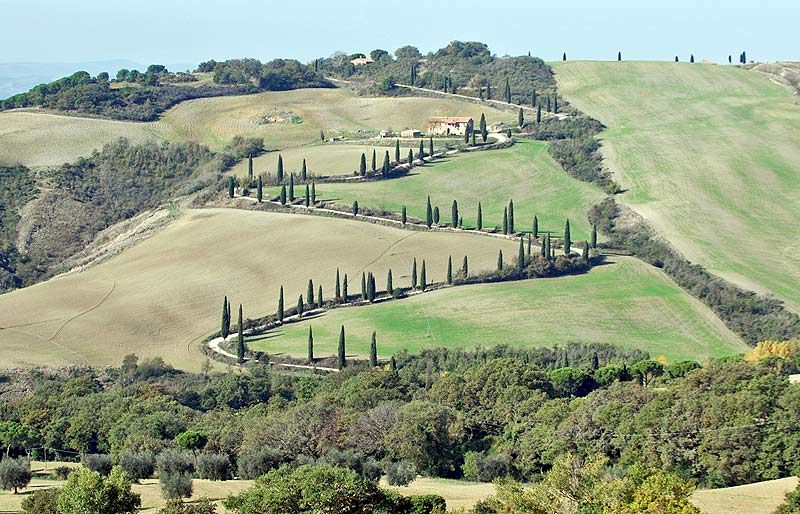
One of the most stunning artificial views was created by Cecil Pinsent. Pinsent was an architect who had the good fortune to find a wealthy and influential patron when he was still in his early twenties. He was taken up by the American art historian Bernard Berenson. [Google all those Berenson's and you will see Marisa was his grandniece] He created quite some gardens in Italy of which I want to mention La Foce, to which this view belonged.
La Foce Benedetta Origo "...And then three years later, after my American great-grandmother had given my parents enough money for a water pipe from a spirng six miles away, he(Pinsent) was able to start this first little garden."
Oh, and this YouTube filmexplains more about La Foce. I almost forgot...
A lot has been written about all of Pinsent's work. Here is another link to another villa: i Tatti,
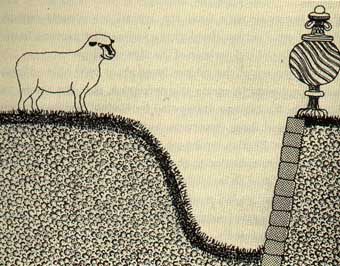
Isn't gardening all about creating views? And should that view not go beyond... what is not yours but could be seen that way? The Ha-ha is the instruments that helps to create a border between your garden and the 'wilderness' beyond. It also helps to keep the sheep out.
Some time ago I came across Coggles, a delightful digital dept. store. It has 'I want' written all over it.
The shop, was apparently named after the secretary of the former husband of founder Victoria Bage. The explanation forthe nameof the shop:Victoria'shusband wascaughthaving an affairwith thissecretary.Victoriadivorcedhimand tookrevengeby the namingthe shopto changethe name ofthesecretary,SarahCoggles. A strong reminder of the creativity rage can arouse.
Founded in 1974in downtownYork, it is now an online store with great content.
At The School of Life all is possible, courses, holidays, 'bibliotherapy', meals, sermons, events and psychotherapy. There's also a shop and ist here that they sell Aphorisms [a set of cards or posters with a clever text, a bit à la Dutch Loesje
The course bear agreeable names like:
How To Be Cool?
How To Have Better Conversations.
How To Find A Job You Love.
How To Spend Time Alone.
How to be a good friend.
Charles Jencks has been making the most interesting postmodern garden in Britain. Jencks, as the leading theorist of postmodernism, has a strong theoretical base
Apart from its striking visual character, the most interesting thing about Jencks Portrack garden is the way it carries forward the ancient project of making gardens which imitate (mimesis) the Nature of nature. Jencks seeks to understand the nature of the world, through science, and to embody the nature of the world in a garden design. The pharaohs, Plato, the emperors of China, Alberti, Capability Brown, William Robinson and Charles Prince of Wales had the same intention. The results differ because their understandings of nature differ.
One criticism I have heard of Jencks’ Portrack Garden is that he is too literal in his ‘imitations’ of physical and chemical laws, principles and formulae. While not seeing this as a fault, I agree with the observation. The alternative would be to use the revelations of science as Jencks’ renaissance predecessors used optics and mechanics to produce remarkable visual effects and devices in gardens. Outside the garden realm, one of the most dazzling examples of what might be done, from the nineteenth century, is the Foucault Pendulum, demonstrating the rotation of the earth. “The direction along which the pendulum swings rotates with time because of Earth’s daily rotation. The first public exhibition of a Foucault pendulum took place in February 1851 in the Meridian Room of the Paris Observatory. A few weeks later, Foucault made his most famous pendulum when he suspended a 28-kg bob with a 67-metre wire from the dome of the Panthéon in Paris. The plane of the pendulum’s swing rotated clockwise 11° per hour, making a full circle in 32.7 hours.” It is not too late to be making Foucault Gardens, Foucault-inspired gardens and other gardens inspired by a scientific understandings of Nature.
British dance group DV8 did some great choreographies in the nineties of the last century. This presenting British pub life as an old boys thing, where being 'different' sets the men into celebrating their macho behaviour at the cost of the 'deveator'.
Go see 'all' their work, visit their awesome and inpiring website: DV8.CO.UK